


Ask any experienced mixologist and you’ll find that many cocktails, particularly the ‘classics’, share a handful of common ingredients. Which is great news for home bartenders: you really don’t need a lot to make fabulous drinks.
Just like the perfect capsule wardrobe that you employ time and again, a ‘cocktail capsule’ collection lets you shake (or stir) up infinite numbers of cocktail varieties, try out the latest cocktail trends or even create your own signature concoctions.
The cocktail building blocks are almost always the same: spirit, bitters/seasoning, sugar and water. Keep these elements at the ready, and you can whip up myriad drinks at a moment’s notice.
The essential spirits
There are no cocktails without spirits, right? But you don’t need to own every bottle under the sun to make sublime mixed drinks.
Just like that essential pair of jeans you can dress up or down, the most useful spirits are the most versatile ones. Gin, vodka, whiskey, tequila, brandy and rum are the most common, appearing in many classic recipes. Purchasing a good-quality, typical example of each means you can make just about anything. Think gin-based cocktails like the Martini and Negroni; whiskey cocktails like the Old Fashioned and Manhattan; popular vodka cocktails like the Moscow Mule; and the tequila-based cocktail du jour, the Margarita.
Some types of cocktails don’t feature just one base spirit – rather two, or even three. Think of the Negroni, which uses an equal-parts ratio of gin, vermouth and bitter Italian aperitif Campari. The most-commonly called for ‘supporting acts’ are dry white vermouth, sweet red vermouth, orange liqueur (like Triple Sec or Cointreau) and aperitifs Campari and Aperol. Wine can be used too; consider champagne-based cocktails like the French 75.
The better you get to know your spirits the better you will be able to use them. When you improve your spirits knowledge and understand the flavours, productions methods and ageing techniques behind each category, you can learn how to adapt recipes to the specific contents of your capsule. For example, once you understand that cachaça is a type of sugarcane-based spirit, you might feel comfortable substituting it in a recipe for another sugarcane spirit like white rum. Think of it a bit like cooking – you’re learning how to balance flavour, sweetness, texture and body to create a perfectly harmonious whole.
The added seasoning
Spirits provide the main base for your cocktail, but the ‘seasoning’ can totally transform its flavour, adding anything from rich brooding notes to a zingy freshness.
The most traditional seasoning is bitters, the highly concentrated, flavourful alcohol that’s comparable to a liquid spice. By far the most widely used is clove and cinnamon-scented aromatic bitters – the biggest brand of which is Angostura.
Fresh citrus or fruit juices can also act like a seasoning. Zingy lemon, tropical lime and sweet orange are called for frequently, as is tart cranberry. Freshly squeezed citrus is always best but if you don’t have it on hand, freeze ice cube trays of fresh juice in advance to pop out when needed; try to avoid using the stuff sold in the bottle.
The sugar
Every cocktail needs a bit of added sweetness to temper the alcohol and seasoning – particularly any intense citrus sourness. Sugar helps give the cocktail a better texture and body too.
Sometimes the sweetness comes from an added liqueur or juice, but often it’s added separately. Occasionally, such as in the traditional Old Fashioned or Champagne Cocktail, recipes call for granulated sugar or sugar cubes. But the majority use sugar syrup as it’s more consistent and easier to mix, so always keep some on hand. You can even make your own sugar syrup by combining equal parts sugar and water on the hob, and heating until dissolved.
White sugar syrup is sometimes called for in fresher cocktails like a Daiquiri – and demerara or agave sugar syrup in richer, aged-spirit cocktails – though in reality the former can do it all.
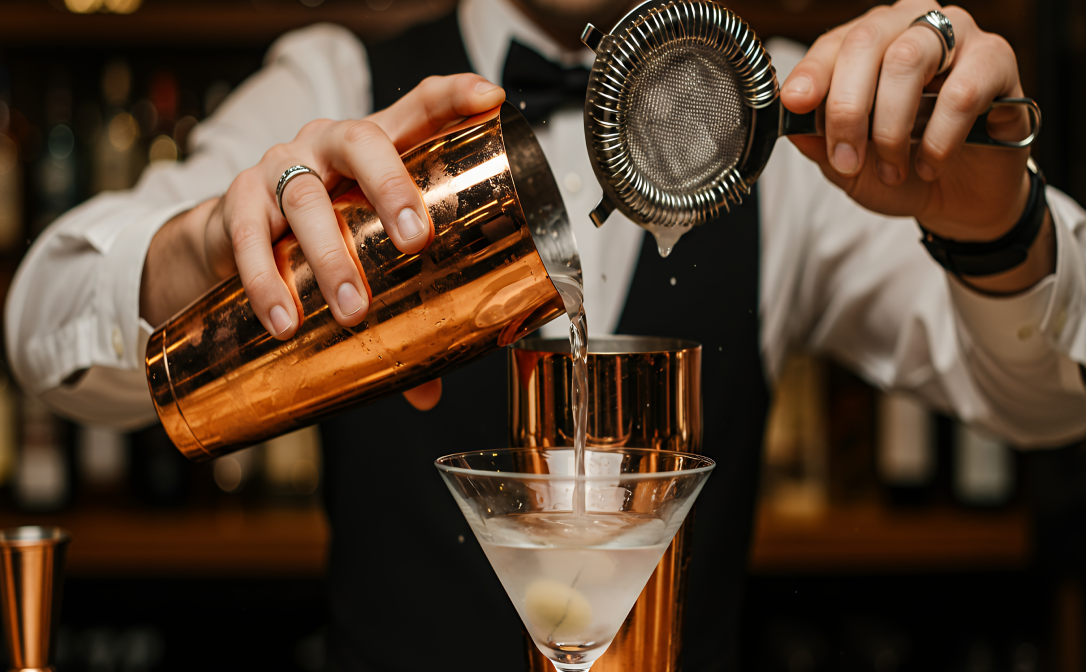
A martini being poured after it has been shaken - or stirred - with ice.
The water
Ice is one of the most overlooked elements of a cocktail, and yet it’s one of the most critical. It not only cools your drink, but dilutes it, becoming part of the finished product and flavour profile.
Commercially produced, shop-bought ice is typically best as it lacks the impurities that home-frozen ice can contain. You’ll especially want to use this in subtle, clean-tasting cocktails such as a Martini.
Your mixing style makes a difference, too. Drinks that are almost pure spirit, for example an Old Fashioned or Martini, should be stirred, while most others should be shaken. Add to your capsule shopping list a simple-to-use and clean Boston shaker and fine mesh strainer, to remove any small shards of ice that might over-dilute your drink. You don’t need a dedicated cocktail mixing glass; a good shaker doubles as both.
The garnishes and kit
Presentation is an important part of cocktail making – after all, you drink with your eyes first.
Crucial to making beautiful cocktails is quality glassware. While standard water glasses can step in for rocks glass or highball drinks (like the Tom Collins) in a pinch, there’s really no substitute for the coupe, which you’ll need for martinis and sours. A wine glass can accommodate not only Champagne cocktails but punches and flips.
Garnishes can be as varied as the cocktail itself and is an opportunity to have fun. Keep salt and sugar on hand for rims on the likes of Margaritas and Sidecars. Dried edible flowers or dehydrated citrus roundels keep well in the cupboard and look sharp floating in a glass. Fresh citrus peel, cut into a twist, elevates almost any drink.
Cocktail tips for the holiday season
Whether you’re hosting a festive party or just treating yourself, the holiday period is one time of year when you might want to expand your cocktail capsule collection. Add some more warming, creamy and indulgent flavours to your arsenal, such as marzipan-sweet Amaretto, Irish cream, crème de menthe and crème de cacao.
Also, do make life easy on yourself and consider a few shortcuts. You can always save time and effort by using some of the best pre-made cocktails or bottled cocktails and adding your own twist via interesting bitters, garnishes and glassware. Or turn drinks preparation into a group activity, inviting friends over and learn how to make classic cocktails together.
