


Choosing wine shouldn’t feel overwhelming, but with so many styles, regions and grapes on the shelves, it can be hard to know where to start. The good news? You don’t need deep wine knowledge to make great choices - just a few simple clues that help you understand what a bottle is likely to taste like.
We asked Lee Isaacs, WSET Educator Development Manager, to share his expert guidance on the key things that can help you pick a wine you’ll genuinely enjoy. From understanding what labels are really telling you to spotting signs of flavour, style and quality, these insights are designed to make choosing wine easier, more intuitive and a lot more fun.
Here’s Lee’s advice:
What is a wine label?
A wine label is a collection of key details, many of which are legally controlled, which give clues as to the wine’s origins, production methods and overall style and quality(ies). In no particular order, here are some items common to most, if not all, labels, and what they mean in terms of your own drinking experience.
Where your wine comes from
All wine labels tell you where the wine has come from. This could be as broad as ‘South-East Australia’ or as focused as naming a specific vineyard. European labels will often feature letters after the named region, such as AC, DO or DOCG. Don’t get caught up with these in the first instance; they reflect that the wine has met a set of laws and rules in the country of production to be granted a particular status.
But why does the origin matter? Over time one learns that there are specific qualities and attributes relatable to micro-factors found in different locations. Lots of wine folk love that because they can use memorised facts to make themselves seem clever or sophisticated. But how can we use the origin to quickly ‘read’ the label (without having to cram our brains with extraneous information that is not useful in any other capacity)?
What’s really useful about understanding the origin is what it says about the climate of the place. This is where a little knowledge of geography is helpful. As a (very general) rule, the cooler the climate the less ripe the grapes, and the warmer the climate the more ripe the grapes. As grapes ripen, their acidity drops, sugars increase and flavours ripen, and tannins increase (in black grapes). So in cooler climates it’s reasonable to expect more acidity, which translates into the mouth as mouthwatering freshness, and more citrus and orchard fruit aromas and flavours for white wine, with more red berry fruits in red wine. In those warmer climates, expect a little less acidity and more stone or tropical fruit characters in white wines, and more black or dried fruit in red wines, alongside higher tannins. This is a very broad rule of thumb, but it’s not a bad starting point.
Grape variety: Your safety net
This is one of the best safety nets for drinkers new to wine and wine labels. There are over 10,000 grape varieties used in wine production globally; however, only 20 or so have any commercial relevance. I am asked more regularly what is meant by ‘variety’; you’ll likely know an apple is not just an apple, but a Granny Smith or Golden Delicious. A grape variety, while clearly a grape, is a specific grape with a unique set of characteristics that present different flavour and texture experiences to drinkers. The grape variety can give you a good indication as to the style and flavour of the wine, and is a good hook on which to hang your tasting hat. Know you like Malbec? Great — seek out more, and chances are good you’ll like the next new bottle. Don’t like Sauvignon Blanc? Steer away from bottles with this on the label. Link this to the above: if the named grape seems to come from a warmer place, it will probably have more tropical fruit flavours if white, and more dark or dried fruit flavours if red.
And if you’re ready to try something new, check out our If you liked that, why not try this? short guide that can give you some examples of similar styles and grape varieties.
ABV and body: How it feels on the palate
This is a really important one to look at. We’re all adults and know the pros and cons of alcohol consumption, but knowing the alcohol of the bottle you’re about to drink is really useful. It may help you decide between having 1 or 2 glasses over lunch. This again links back to the climate type; warmer climates allow grapes to build more sugars, and more sugars tend to mean more alcohol. If you’re aware of the term body in wine, there’s a link here too. Body means the weight and feel of the wine in the mouth. If you like powerful flavours and impactful wines, then higher alcohol levels should reflect this.
Spotting oak on the label
Oak is often used in wine production as it makes great storage vessels for wines while they’re fermenting, or to keep them in until they’re ready to bottle. Oak has got a bad rep from some overuse in the 1980s (subtly glances at Australia). At its best, oak can add delicate flavours of vanilla, cedar and sometimes coconut. Oak is often treated over a flame, so there can be some smoky flavours to be found. Have a sneak at the back label and it might give you details on the length of time the oak was used; the longer, the more prominent those oak flavours will be. Often the terms Reserve/Reserva/Riserva will appear and, more often than not, they suggest that the wine has spent some time in contact with oak. Conversely, the term ‘Unoaked’ is appearing more, and as suggested, it means you won’t find those vanilla and cedar aromas and flavours.
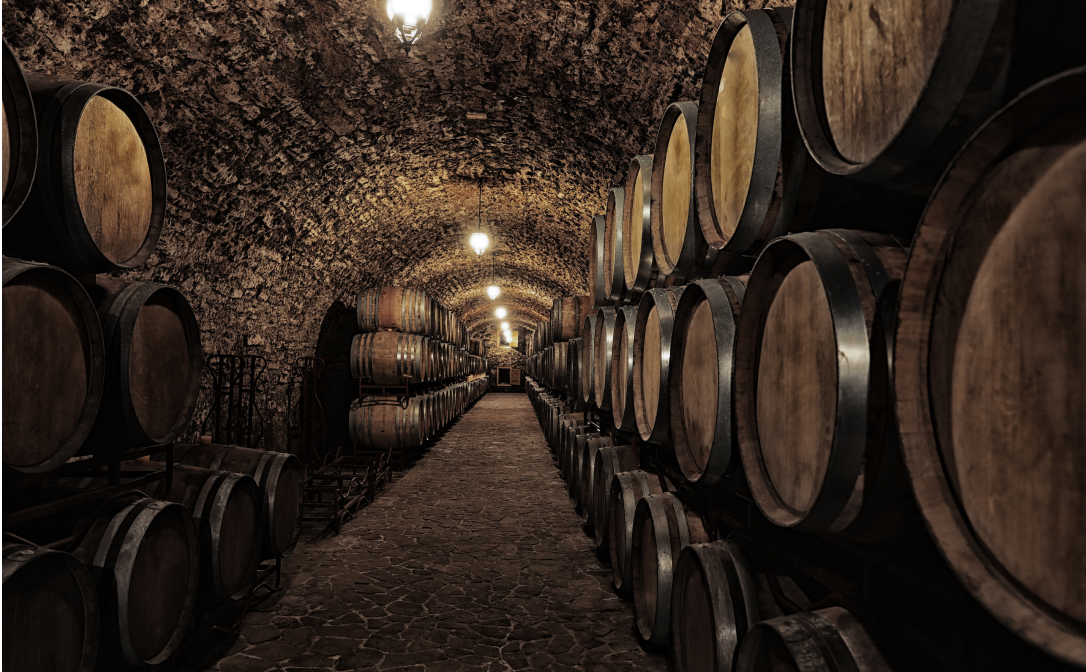
A wine cellar interior.
Dryness vs. sweetness
This is a reflection of how much sugar is left over in the wine after the sugars in the grapes have been turned into alcohol. Most wines have very little sugar, and we describe them as dry. This does seem counterintuitive. I was once asked by a student, “How can a wine be dry when it’s a liquid, which is wet?” Remember, it’s the absence of detectable sugar. Usually, if the wine has some degree of sweetness, it will tell you in the description. Some retailers use a numbering system of 1–5; the higher the number, the sweeter the wine.
Getting to know your producers (and why it helps)
Most labels will feature the name of the producer of the wine, although this can sometimes be harder to find if it is a supermarket own label. As you try more wines, make a note of the wines you’ve enjoyed and who has produced them. Wine producers tend to have a ‘house style’ that will be a detectable (by which I really mean tasteable) theme in their wines. If you know you don’t like a particular grape variety you can still avoid it, but when trying a variety for the first time it’s worth trying it from a producer you know you like.
BOBs (Buyer’s Own Brands) can often represent excellent value for money. These wines not only have to reflect the quality of the producer but of the retailer themselves. The best own-label wines indicate the actual producer clearly on the label whilst retaining the identity of the retailer, and not only give good bang for buck, they can also allow you to try something new without forking out heaps of cash.
Understanding vine age
The older the vine, the less fruit it produces. But the quality of the fruit produced tends to be higher, meaning more concentrated with aroma and flavour. Look for the terms Vieilles Vignes (France), Vigne Vecchie (Italy), Viñas Viejas (Spain), Vinhas Velhas (Portugal) and Alte Reben (Germany) for wines made from older vines. Although beware: the term old vine, in any language, does not yet have a specific legal definition.
Vintage: What the year really tells you
We get a bit caught up talking about vintage, as if it’s some quasi-mythical attribute of a wine that may or may not represent greatness. You’ll have seen people hoist a bottle to their face and peer over their glasses to tell you, ‘This was a good vintage’. Without any other context of region, producer, variety or production, it’s not especially helpful. The vintage is simply the year in which the grapes were grown, harvested and turned into wine. Most wines are made to be consumed without the need for ageing, and a good rule to follow is: if the wine is particularly cheap and more than a year old, it may be a bit past it. As wines age, they tend to lose the freshness of the fruit and develop more earthy, savoury flavours; so if you like those, look for something with a bit of age on it.
Closures: Cork or Screwcap?
Seeking closure on a challenging life experience can often end with one needing a glass or two of wine. Closure in wine, though, refers to how the bottle has been sealed. Thankfully, the days of people being judgmental and wary of screwcaps are almost completely behind us. The type of closure does not reflect the overall quality of the wine. Screwcap wines tend to be designed for younger, fresher drinking, with cork stoppers still the choice for wines aiming to change and develop over time in bottle. If nothing else, a screwcap bottle is easy to reseal and stick in the fridge to keep over to the next day… and there’s no need for a corkscrew.
Packaging type
Similar to closures, the days of canned wine just being a vehicle for any old naff alcohol are behind us. As consumers globally look to moderate their alcohol intake, wine in cans is a great option. The quality of many canned wines stands up against their bottled contemporaries, and they’re also a good way to try a new grape variety, region or producer without having to purchase a full bottle.
Price: Does spending more equal better wine?
The age-old question: is expensive wine ‘better’? We need to reframe the meaning of better to be about your enjoyment of the bottle as a consumer, rather than a set of technical criteria. As with most things, the more expensive the wine, the higher the quality level. It may be more concentrated, complex and age longer. It will likely be more scarce and therefore offer a more unique drinking experience. It may have used the finest oak barrels known to humanity to subtly and delicately leave the wine with a whisper of ancient Tolkienesque forests. But none of this relates to your own enjoyment. If your favourite wine is a £10 Australian Shiraz, then it’s unlikely that a £100 aged red Burgundy will provide the same level of fun or enjoyment. It’s not to say you can’t ‘appreciate’ the Burgundy; it’s just that, as a wine, it does something totally different to the Australian Shiraz. If you’re going to spend more on a wine as a treat, stay within the areas you know you like, as you’re more likely to get something you know you enjoy. If you want to try something completely new, it’s a higher-risk gambit.
How to get the best bottle for you
If it’s possible, talk to someone who knows more about the subject than you. Trained wine professionals know more for a reason; they’re often nerds (I use this term positively, and it applies directly to me) who enjoy collecting data and facts about the products with which they work — not to show off or appear smarter or more cultured, but to help others find as much joy in a bottle as they do. A good wine professional will ask you, the consumer, questions about your preferences in order to make sure their recommendation is as suitable as possible. If you can’t make it into a specialist drinks retailer, start with some of the guidance above to help you find the bottle you most enjoy.
If you'd like to learn more about wine regions, climates, grape varieties and aromas, you'll love our Level 1 or Level 2 Awards in Wines.
